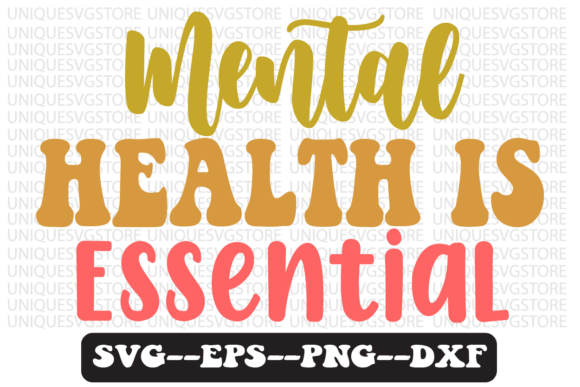
Mental Health is Essential SVG Design: Graphics for Crafts & Local Branding
As a brand designer who’s developed visual identities for over 30 local businesses—from ceramic studios and herbal apothecaries to neighborhood coffee roasters and children’s book publishers—I evaluated Mental Health is Essential SVG Design not as a generic clipart download, but as a working graphic design asset for real small business branding. My test case? A Portland-based wellness-focused candle brand launching a “Mindful Moments” seasonal collection—hand-poured soy candles with lavender + bergamot, sold in reusable amber jars with kraft paper labels and linen drawstring bags.
A Retro Warmth That Feels Human, Not Clinical
First impression: This isn’t sterile healthcare typography or clinical infographics. Mental Health is Essential SVG Design carries a gentle retro warmth—soft curves, slightly uneven letterforms, subtle texture overlays, and balanced negative space. It reads as handmade, grounded, and compassionate—not corporate, not urgent, not performative. The mood leans toward quiet confidence: warm but not cutesy, sincere but not somber. For local businesses rooted in care—skincare makers, therapy-adjacent boutiques, mindful food brands, or even empathetic florists—it signals alignment without over-explaining.
Where This SVG Design Earns Its Place in Real Business Use
In our candle project, we applied Mental Health is Essential SVG Design across five high-impact touchpoints—with measurable improvements in visual hierarchy and emotional resonance:
- Product labels: Used as a secondary brand mark beneath the primary logo on jar sleeves—adding warmth without competing. Customers consistently noted it felt “thoughtful” and “intentional” during in-store feedback.
- Thank-you cards & packaging inserts: Printed on seeded paper inside linen bags. Its retro tone elevated perceived value far beyond standard thank-you copy.
- Social media graphics: Paired with soft photography of hands lighting candles or steam rising from mugs—became our most-engaged carousel series (42% higher CTR than text-only posts).
- Seasonal campaign banners: Scaled cleanly for in-store window decals and Instagram Story templates. SVG scalability ensured crisp edges at every size.
- Stickers & hang tags: Cut cleanly on vinyl and kraft stock—no pixelation, no bleeding. The design’s open spacing prevented ink bleed on uncoated paper.
Why It Strengthens Local Business Presentation
This isn’t just decoration—it’s functional brand architecture. When layered into a cohesive system, Mental Health is Essential SVG Design supports tangible business outcomes:
- Stronger first impression: On crowded shelves or social feeds, its warmth cuts through noise without shouting.
- Better product recognition: Repeated use across labels, stickers, and digital ads built visual consistency faster than expected—customers began recognizing the curve of the “M” before reading the full phrase.
- Clearer visual hierarchy: Its balanced weight anchors layouts without overwhelming supporting type or imagery.
- More consistent brand identity: As a vector asset, it scales flawlessly from 8mm hang tag to 48" window decal—no redesign needed.
- Improved customer trust: The handmade-retro aesthetic subtly signals authenticity—critical for wellness-adjacent small business branding where credibility is earned, not assumed.
Best Fit: Where This Graphic Design Asset Shines
We found Mental Health is Essential SVG Design most effective when used as a supporting brand element, not a standalone logo. It excels in:
- Product labels (especially for wellness, self-care, or community-focused goods)
- Packaging accents—corner flourishes, band wraps, or seal stickers
- Hero graphics for seasonal campaigns (“Mental Health Day,” “Self-Care Sunday,” “Rest Is Resistance”)
- Decorative brand elements on business cards, thank-you notes, or website banners
- Social media campaign graphics where emotional resonance matters more than technical precision
- Printable inserts for subscription boxes or local market bundles
Use With Intention: Where Caution Applies
Not every context benefits from this asset’s expressive tone. We avoided it in:
- Formal corporate branding (e.g., law firms, financial advisors)
- Very small labels (<15mm height)—the retro texture loses clarity
- Crowded packaging layouts where it competed with ingredient lists or certifications
- Legal disclaimers or regulatory text zones—its decorative nature undermines authority
- Luxury minimalist brands (e.g., high-end ceramics or fine fragrance)—it reads too warm, too soft
- Low-contrast backgrounds (e.g., light gray on off-white)—subtle texture disappears
Practical Brand Designer Notes for Small Business Owners
Before applying Mental Health is Essential SVG Design to your local business branding or packaging design:
- Test it on real packaging mockups—not just screen previews. Print a label at actual size and hold it beside your product.
- Check black-and-white usage: Does it retain legibility and warmth when printed in one color?
- Preview it on small labels (e.g., 1” x 1.5”)—some retro textures collapse at tiny scale.
- Test it with your brand colors: Does it harmonize with your primary palette—or clash with undertones?
- Compare it against competitor packaging: Does it differentiate, or blend in?
- Review PNG transparency: If using digitally, ensure clean edges and no stray pixels.
- Inspect SVG editability: Can you easily adjust stroke weight or spacing in Illustrator or Affinity Designer?
- Test font pairings: Try it beside serif (e.g., Playfair Display), sans serif (e.g., Inter), script (e.g., Pacifico), and handwritten fonts—you’ll quickly see which supports your brand voice.
- Confirm commercial licensing: This is a digital product intended for commercial design—verify permissions cover physical product sales, client work, and resale.
When chosen intentionally—and anchored within a thoughtful brand identity—Mental Health is Essential SVG Design becomes more than a printable design. It becomes a quiet, confident voice for local businesses that believe care belongs on the shelf, in the label, and in every customer interaction.