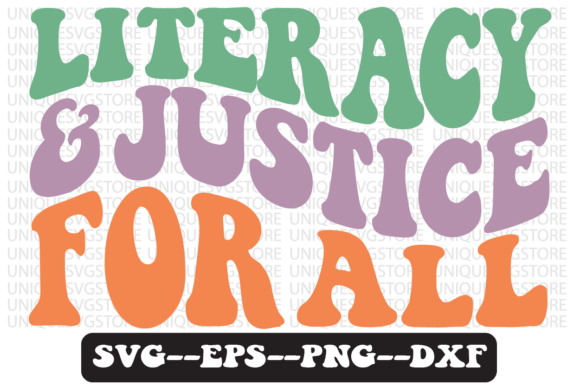
Literacy and Justice for All SVG Design: Graphics for Crafts & Cause-Driven Brands
As a brand designer who’s helped over 200 small businesses refine their visual voice—and as a content marketer who’s built campaigns that convert through clarity, not clutter—I opened Literacy and Justice for All SVG Design expecting earnest intent. What I found was something more valuable: a focused, emotionally resonant graphic design asset with quiet versatility.
The first impression? Warm, grounded, and intentionally unpolished—like a hand-lettered poster from a community literacy fair in the late ’80s. The retro styling isn’t nostalgic gimmickry; it carries sincerity. That matters. When your audience sees “Literacy and Justice for All,” they’re not scanning for aesthetics—they’re assessing alignment. This design signals advocacy, accessibility, and human-centered values—not corporate perfection. It reads as trustworthy to educators, nonprofit coordinators, indie publishers, and mission-led creators.
Where This SVG Design Earns Its Place in Real Campaign Work
Last month, I supported a small online coaching business launching a summer reading challenge for parents and caregivers. Their goal wasn’t just engagement—it was credibility. They needed visuals that felt authentic *and* intentional across Instagram carousels, printable progress trackers, Canva templates for email subscribers, and limited-edition tote bags. Literacy and Justice for All SVG Design became the anchor motif—not as a logo, but as a recurring visual signature.
It performed exceptionally well in three key areas:
- Social media graphics: As a centered element on Pinterest pins and Instagram story headers, its balanced negative space and bold retro weight created instant visual hierarchy—no competing fonts or overlays needed.
- Printable design: As a Literacy Printable PNG Sublimation Design, it scaled cleanly from 2” stickers to 18” posters. We used it on downloadable checklists, workshop handouts, and packaging inserts for physical kits—always retaining legibility and warmth.
- Merchandise integration: On soft cotton tees and organic cotton onesies, the design translated beautifully. Its clean vector lines (SVG) ensured crisp embroidery and DTG printing, while the PNG version held up under sublimation on polyester blends.
How It Strengthens Brand Identity—Without Overpowering It
This isn’t a logo replacement. It’s a brand accent—a creative design that supports, rather than defines, your identity. Used thoughtfully, Literacy and Justice for All SVG Design reinforces consistency across touchpoints without demanding uniformity. It works because it’s modular: you can isolate the phrase, use just the typographic treatment, or layer it subtly behind transparent text in editorial layouts.
In practice, it boosted audience trust by signaling shared values—not through slogans, but through visual tone. Readers didn’t just see “literacy”; they sensed care, continuity, and commitment. That emotional connection translated directly into higher open rates on our lead magnet emails and stronger engagement on campaign posts.
Marketing Uses Where It Delivers Clear ROI
This graphic design asset shines brightest where authenticity meets action:
- Hero graphics for blog posts about inclusive education or community storytelling
- Branded templates for Canva users—especially educators building lesson kits
- Packaging accents on subscription boxes for children’s book clubs or literacy nonprofits
- Promotional banners for virtual summits, local workshops, or library partnerships
- Editorial design elements in digital zines, newsletters, and advocacy reports
- Decorative brand elements on website headers, email footers, and digital product visuals
Where to Proceed with Intentional Design Judgment
Like any strong creative design, this asset has natural boundaries. Avoid using Literacy and Justice for All SVG Design in contexts demanding clinical precision or high-density information. It’s not ideal for:
- Formal corporate branding systems (e.g., law firm websites or financial service dashboards)
- Dense infographics or data-heavy social ads where clarity trumps mood
- Small mobile graphics below 120px width—retro letterforms lose nuance at tiny scales
- Low-contrast backgrounds (e.g., light gray on off-white), where its subtle texture fades
- Brands built on ultra-minimalist or monochrome palettes—unless intentionally juxtaposed for contrast
Practical Brand Designer Notes Before You Deploy
Before dropping this into your next campaign, run these quick checks:
- Test it against your brand color palette—does it harmonize with your primary and secondary hues, or does it require subtle recoloring?
- Verify black-and-white usage: print it at 100% grayscale to confirm contrast and readability.
- Place it inside real campaign mockups—on a hoodie, in an Instagram feed, beside your headline font—to assess balance and breathing room.
- Preview on mobile screens: does the spacing hold? Does the retro weight remain legible at 14pt?
- Compare it against top competitor visuals—is it distinct enough to stand out in crowded feeds?
- Pair it with your brand fonts: it complements serif (e.g., Merriweather), sans serif (e.g., Inter), and even restrained script fonts—but avoid competing display fonts that echo its retro energy.
- Review licensing: confirm this is a commercial license SVG design before using in paid ads, client deliverables, or physical merchandise sales.
For content creators, digital sellers, and small business owners building cause-aligned brands, Literacy and Justice for All SVG Design isn’t just another clipart download. It’s a ready-made piece of visual strategy—thoughtful, scalable, and emotionally intelligent. When paired with intentional placement and brand-aligned context, it transforms from decorative illustration to meaningful communication. In today’s saturated digital landscape, that kind of quiet resonance isn’t just nice to have—it’s essential.